How to choose the first Freewing jet for student or beginner?
Hello Hobby friend:
I am general technology engineer from Freewing model.
we are happy to share technology with all hobby friend again today.
How to install EDF Engine power system for Freewing avanti 90mm edf jet step by step?
How to choose the first Freewing jet for student or beginner?
jet shouldn't be the first airframe a student flies — but if they've already soloed a prop trainer, the Freewing 64 mm F‑105 Thunderchief (or the 64 mm F‑22 / F‑8 Crusader park jets) is the right entry point, and a 70 mm Yak‑130 / L‑15 / Hawk T1 is the natural second step.
Why the student tage matters more than the model
Freewing's own product line splits at 64 mm vs 70 mm+, and the difference is not size — it's wing loading, landing speed, and cost per crash. EDFs have throttle lag and a glide ratio like a brick, so a pilot who can't yet land a prop plane consistently will destroy a jet in the landing pattern, not in the air. If the student is still learning circuits and landings, buy a high-wing prop trainer first (Freewing's own Pandora 1400 mm 4-in-1 exists for exactly this) and fly the jet on a simulator in parallel.
Selection criteria, in priority order
| Criterion | What to look for | Why |
|---|---|---|
| Wing loading | Low; straight or slightly swept wing, generous area | Determines landing speed — the #1 beginner killer |
| Wing position | Shoulder/mid wing with a belly skid plate | Survives belly landings, tolerant of hand launch |
| Control surfaces | Aileron + elevator minimum; rudder and flaps a bonus | Fewer surfaces = fewer failure points, but flaps lower landing speed |
| Gear vs hand launch | Paved field → geared version; grass field → hand launch + belly land | Hand launching an EDF is a skill of its own |
| Cell count | 3S–4S, 1000–2200 mAh | Cheap batteries, cheap ESCs, lighter airframes |
| Parts availability | Fan units, nose cones, wings in stock locally | A first jet will be crashed; repairability is the real budget |
| Stabilization | Room for a small gyro / gyro-equipped receiver | Buys time in turbulence and on approach |
Concrete Freewing options
Tier 1 — true first jet
- 64 mm F‑105 Thunderchief — explicitly designed as an "ideal first hand-launch EDF," 530 mm span, 360 g empty, 3S 1000 to 2200 mAh, 30 A ESC, two servos with elevon mixing, 116 km/h top speed, optional steerable gear. Belly skid plate and low wing loading make the landing pattern manageable.Freewing ModelMotionRC Caveats: elevon-only (no rudder), and the overhand toss is the single hardest moment — practice it on a prop plane first.
- 64 mm F‑22 Raptor, F‑8 Crusader, Stinger 64 — the same park-jet family, similar weight class, some with 4S and landing gear.
Tier 2 — second jet, once Tier 1 is boring
- 70 mm Yak‑130 — real-world trainer lineage, large wing area for a 70 mm airframe.
- 70 mm L‑15 / Hawk T1 — 6S, retracts and flaps, sport-jet handling; the L‑15 is positioned as an "advanced trainer" for pilots moving up from 64 mm class.东莞市飞翼电子科技有限公司Freewing Model
Avoid as a first jet — 90 mm F‑16/F‑15/F‑18, twin 80 mm MiG‑29, anything with high wing loading, delta wings without tails, or a scale fighter whose landing speed exceeds what the student can judge on approach.
The non-airframe checklist
- 20–30 hours on a sim with the same model before the maiden.
- Expo and low rates set by an instructor, not by feel.
- Buddy-box the first three flights.
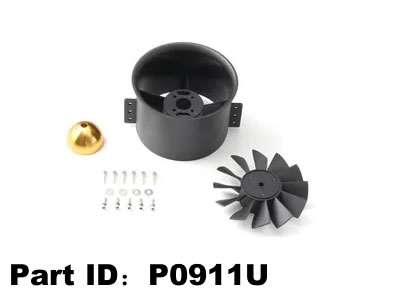
- Three batteries and one spare fan unit bought up front — flight time is 3- 4 minutes, and the fan is the part that eats gravel.
- Maiden on a calm morning, over grass, with the CG checked at the manual's point, not "about right."